How to Start a Successful Cleaning Business That Lasts
To start a successful cleaning business, get three things right from the first month. Keep the clients you win, price every job so it pays you and the business, and focus on one kind of cleaning for one kind of customer. Plenty of people can start a cleaning business in a week. The ones still trading years later almost always did those three things well.
Everything else, from the logo to the software, matters less than it looks. This guide covers what separates a cleaning business that lasts from one that fades, and what to do about each part in the first year. For the full launch sequence, start with the guide on how to start a cleaning business and come back here.
What success looks like in a cleaning business
Success here is not a busy calendar. A calendar can be full of one-off jobs priced too low, and that owner works harder every month for the same money. A successful cleaning business has a base of recurring clients, a price that leaves a profit after every cost, and an owner who is not working sixty hours a week to hold it together.
That definition matters because it changes what a new owner chases. Someone counting jobs will say yes to anything. Someone counting recurring clients and profit per hour will turn down work that does not fit, and that is usually the better business by the end of year one.
Here is how the same three areas look in a business that stalls and one that lasts.
| Area | The business that stalls | The business that lasts |
|---|---|---|
| Retention | Wins clients, then rarely hears from them again | Checks in, fixes problems fast, keeps clients for years |
| Pricing | Copies the cheapest rate in town | Prices from its own costs plus a margin |
| Focus | Takes any job, anywhere, of any kind | One service, one client type, a tight area |
None of the right-hand column costs money. Each one is a decision the owner makes early and then keeps making. The rest of this guide takes them one at a time, starting with the one most new owners underrate.
Why client retention decides most outcomes
Retention means keeping a client booked month after month. In residential cleaning it is the single biggest driver of whether the business makes money, because a recurring client costs nothing to win a second time. Every client who leaves has to be replaced with marketing, quoting and a first clean that usually takes longer than the rest.
The research on this is old and still holds. Bain & Company's work on customer loyalty, set out in Bain's paper on loyal customers, found that in financial services a 5% increase in customer retention produced more than a 25% increase in profit. Cleaning is a different trade, but the mechanism is the same. Returning customers cost less to serve and buy more over time.
We see the same pattern in our own work. Here at the Cleaning Business Institute, we've found that owners who lift their client retention by five points over a year typically see profit rise by a quarter or more. The jump comes from fewer first cleans, fewer quotes and less money spent finding replacements.
Here is the arithmetic on one client, as an illustration. Assume a fortnightly clean at $150, which is 26 visits a year.
The same client, won with the same effort, is worth twenty-six times more if they stay three years.
So the practical question is how to keep them. The habits that work are plain, and most cost only attention.
- Use a written checklist for every clean so the standard does not drift from visit to visit.
- Send the same cleaner where possible. Clients bond with a person, not a brand.
- Ask for feedback after the second and sixth cleans, when small problems are still small.
- Fix a complaint within a day, and fix it generously.
- Keep notes on each home, such as the pet's name, the fragile vase and the room they care about most.
A free cleaning service checklist template is a sensible starting point for the first item on that list.
How to price so the business pays you
Underpricing is the most common reason a busy cleaning business still struggles. A low price wins the first job, but it leaves no room for insurance, supplies, travel, taxes or a day off. The owner then has to work more hours to stand still.
The fix is to price from costs upward instead of copying a competitor. Here is how that works on a three-hour house clean, using assumed figures.
Pay yourself $30 an hour for three hours ($90). Add $6 of supplies, $8 for travel and $10 as this job's share of insurance, phone and software. That is $114 of cost. A 20% margin on top brings the price to about $137.
That $137 is a floor, not the answer. Local demand, the condition of the home and what the client wants included can all push it up. The point is that nobody should quote below it. The guide to cleaning business pricing models covers hourly, flat and square-foot pricing, and the cleaning price calculator runs the same arithmetic on your own numbers.
Taxes belong in that thinking too. A self-employed owner pays income tax and self-employment tax, and the IRS explains on its estimated taxes page that most people expecting to owe $1,000 or more must pay in quarterly. Setting aside a fixed share of each payment avoids a painful bill in April.
Why focus beats taking every job
A new owner usually says yes to everything, because every job feels like proof the business works. In practice a scattered client list costs more than it earns. Driving across town for a one-off clean, then switching to an office job with different products, eats the hours that should have been paid work.
Focus means choosing three things and holding to them for the first year or so.
- One service. Recurring house cleaning, Airbnb turnovers or small offices, for example, each with its own kit and rhythm.
- One client type. Busy two-income households want different things from landlords or property managers.
- One area. A tight radius means more cleans per day and less unpaid driving.
That does not lock the business in forever. Once the first service runs well, adding a second is far easier. The guides to starting a house cleaning business and starting a commercial cleaning business help with the choice of where to begin.
Signs the focus is working
Focus pays off in ways that are easy to spot within a few months. Referrals start arriving from clients who know neighbors with the same needs. Cleans get faster because the same tasks repeat. Quotes get easier because the owner has done dozens of near-identical homes.
If none of that is happening after six months, the chosen niche may be too thin in that area. That is a reason to adjust the focus, not to abandon it.
The mistakes that end most early cleaning businesses
The businesses that close in the first couple of years tend to share the same few mistakes. None of them is dramatic. Each one quietly takes away time or money until the owner decides it is not worth it.
- Pricing below cost, then trying to fix it by working longer hours.
- Chasing new clients while old ones drift away, so the business refills the same bucket every month.
- Skipping a written agreement, which turns scope and cancellation into arguments. A cleaning service contract template covers the basics.
- Hiring too late, after the owner is already exhausted and has no time to train anyone well.
The last one is a question of timing more than money. The guide on how to build a cleaning business covers when and how to add systems and people once the base is stable.
How the course fits
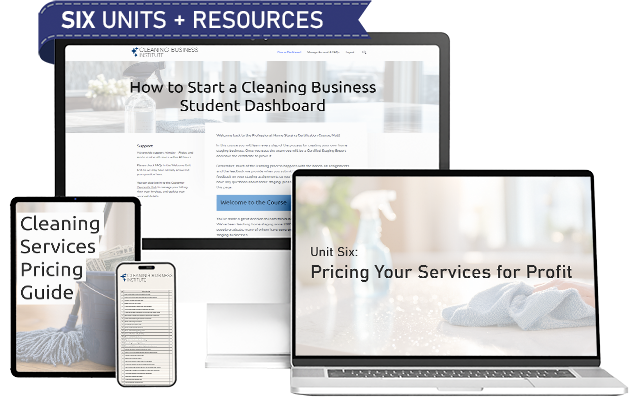
The three areas above are taught in depth in the Fundamentals Course. Unit 3, Pricing Your Services for Profit, works through true cost, pricing models and how to handle price objections. Unit 5, Client Experience and Retention, covers onboarding, complaints and the systems that bring repeat business and referrals. Unit 1 helps with choosing a niche.
The Fast Track Course includes all of that and adds four units on what comes next, including Unit 9, Hiring and Growing Your Team, and Unit 10, Scaling and Long-Term Growth. Both tiers lead to the same C.C.B.P. certification exam.
Ready to get started?
Our step-by-step courses take you from where you are now to a credential you can show, with templates, an online exam, and a 30-day money-back guarantee.
See the courses