Frequently asked questions
Straight answers about the course, the C.C.B.P. certification, and what it actually takes to start and run a cleaning business, including the licenses and other certifications people ask about.
About the courses
Is this course 100% online?
The entire course is online, so you can study from anywhere at any time, including in the gaps between cleans. There are no in-person classes, meet-ups or live sessions to schedule around.
What's the course format like?
The course is written, not video. Each unit is a read-through with worked examples from cleaning businesses at different stages, followed by a practice quiz and two short assignments that you apply to your own business. You get instant access to your student dashboard the moment you enroll.
What's included in the course content?
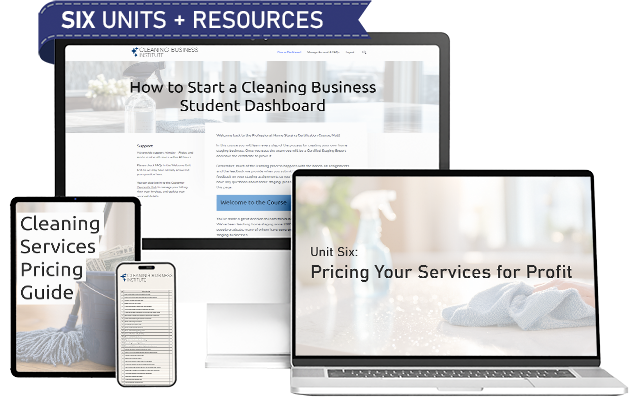
The Fundamentals Course includes the first 6 units: cleaning business foundations; setting up your business; pricing your services for profit; cleaning techniques and standards; client experience and retention; getting your first clients. The Fast Track Course adds the remaining 4: marketing on a budget; systems for efficiency; hiring and growing your team; scaling and long-term growth.
Do I need cleaning experience or any qualifications to enroll?
No. There are no education requirements and you do not need to have cleaned professionally. If you have kept your own home carefully for years, what you most likely need is the business side, meaning pricing, paperwork and finding clients. Unit 4 covers professional techniques for anyone who wants them.
Pricing and guarantee
How much does the course cost in total?
We offer two options depending on how far you want to go. The Fundamentals Course is $247 and covers starting and running a solo business. The Fast Track Course is $498 and adds marketing, systems, hiring and commercial growth. You can compare both on the courses page.
Why does this cost less than other business courses?
Because it is written, self-paced and delivered entirely online, there are no classrooms, no live instructors on a timetable and no printed materials to pay for. The one part that costs us real time, a person reading your written exam answers, is kept.
Will I have to pay any extra or ongoing fees?
No hidden charges, subscription fees, or renewal fees. You pay once for your course, the exam and certificate are included, and a resit costs nothing.
What if I change my mind or can't finish the course?
Both courses come with a 100% money-back guarantee. If you decide the training is not right for you, just email us within 30 days and we will refund your payment, no questions asked.
Certification and exam
Can you tell me more about the exam?
You take an open-book online exam of 30 multiple-choice questions and 4 short written answers. You need at least 70 out of 100 to pass. You get up to 2 attempts and a resit costs nothing, with no waiting period in between. The exam is one sitting rather than something you save and come back to, so give yourself a clear hour.
How long does marking take?
The multiple-choice half is scored the moment you submit. The written half is read by a person, usually within two business days, and your result arrives by email. If you do not pass, you get notes on what would have earned full marks rather than just a number.
Do I get a certification when I finish the course?
Yes. Once you complete the course and pass the exam, you receive a personalized digital certificate with your name and the date you finished, naming you a Certified Cleaning Business Professional (C.C.B.P.).
What happens if I fail?
You resit it, at no cost, up to 2 attempts in total. Your result email tells you your score, splits it between the multiple-choice and written halves so you know where to focus, and includes any notes your marker left. You can sit it again as soon as you are ready.
Cleaning certification questions
Is the C.C.B.P. certification a license to run a cleaning business?
No. The C.C.B.P. is a training certificate showing you completed the course and passed an exam on running a cleaning business. It is not a government license. In the United States there is no national cleaning license. Whether you need a business license, and which one, is decided by your state, county and city, and the course shows you how to find out. Our guide to what licenses a cleaning business needs explains the usual requirements.
Do I need a certification to start a cleaning business?
In most places, no. No certification is legally required to clean homes or offices. What you usually do need is a business registration, any local license your city or county requires, and liability insurance. A certification becomes useful when a client or a type of work expects one, such as a commercial buyer comparing bids or a specialty like carpet or water damage work, where technical certifications are the norm. See how to get licensed and insured.
Is an online cleaning business certification worth it?
It is worth it if you want the business skills it teaches, and not if you only want a line for your business card. The value is in knowing how to price a job so it pays, what to put in writing, how to get and keep clients, and when to hire. The certificate shows clients you took that training seriously. If you want to judge the content first, the template guides and blog are free.
How long does it take to get certified?
It depends on your pace, since the course is self-paced with no deadline. Each unit takes roughly forty minutes to read, plus time for the quiz and the two assignments. The Fundamentals Course has 6 units and the Fast Track Course has 10. The exam is one sitting of about an hour, and written answers are usually marked within two business days. A unit or two a week is a comfortable pace alongside other work.
How much does cleaning business certification cost?
The certificate is included in the course price, with no separate exam fee and no renewal fee. The Fundamentals Course is $247 and the Fast Track Course is $498, and both lead to the same C.C.B.P. credential. A resit is free, and there is a 30-day money-back guarantee. Compare them on the courses page.
Is this certification accredited?
No, and we would rather say so plainly. The C.C.B.P. is not accredited by an outside body or issued by any government. It is our own credential, awarded to people who finish the course and pass an exam that includes written answers read by a person. The certification standards page sets out exactly what a holder has shown they can do, and every certificate can be checked on our verification page.
How is the C.C.B.P. different from an IICRC certification?
They certify different things. The IICRC certifies technicians in specialties such as carpet cleaning and water damage restoration, and those certifications are expected in carpet and restoration work. The C.C.B.P. covers the business side: pricing, setup, client retention, marketing, hiring and contracts. If you plan to offer carpet or restoration services, get the IICRC certification for that trade as well. Our guide on starting a carpet cleaning business covers where it fits.
What is ISSA cleaning certification, and do I need it?
ISSA is the international cleaning industry association. Its best-known certification is the Cleaning Industry Management Standard (CIMS), which certifies cleaning organizations rather than individuals after an assessment of how they are managed, and it also offers training programs. Some larger commercial buyers look for CIMS. A new residential business does not need it. It is something a growing commercial company might work toward, and the C.C.B.P. is a sensible step before it. See starting a commercial cleaning business.
Is there an OSHA certification for a cleaning business?
Not in the sense most people mean. OSHA does not certify cleaners or cleaning companies. What OSHA does is set rules, and two matter most in cleaning. Employers must train staff on the hazardous chemicals they use (hazard communication), and workers who may be exposed to blood, which can include some medical and commercial cleaning, need bloodborne pathogens training. OSHA Outreach courses issue a completion card rather than a certification. Plan for this training before you hire, which our hiring guide covers.
What is a green cleaning certification?
It usually means one of two things. Products can carry third-party environmental certifications, and cleaning services can be certified too, for example by Green Seal to its GS-42 standard for commercial cleaning services, or through the green building version of ISSA's CIMS. Service certifications involve an audit and are mainly sought by commercial providers whose clients want green building credentials. For a residential business, using certified products and saying so accurately is often enough. The C.C.B.P. does not certify green practices.
Do I need a special certification for window, hood or medical cleaning?
These specialties are where technical training matters most. Kitchen exhaust hood cleaning is governed by fire codes, and many local fire authorities expect it to be done by trained, certified technicians. Window cleaning at height brings fall-protection rules and safety standards. Medical and dental cleaning brings bloodborne pathogens training and infection control expectations. Check with your local authority and your clients before offering any of them. Our guide to starting a window cleaning business is a good place to begin.
How can a client check my certification?
Every C.C.B.P. certificate carries a unique verification ID. Anyone can enter it on our certificate verification page to confirm it is genuine, whose it is and when it was issued. Holders are expected to describe it accurately, as completed business training and not as a license, under our code of conduct.
Starting a cleaning business
What licenses are needed to start a cleaning business?
It depends entirely on where you are. In the United States most owners need to register the business with their state (or file a trade name), and many cities and counties require a general business license. Some services, such as pressure washing, can bring extra permits. Search your city or county with "business license requirements" and read the official page. Our guide to cleaning business licenses walks through each one, and Unit 2 of the course turns it into a checklist.
Do I need a license to start a cleaning business from home?
Usually you still need whatever general business license or registration your city requires, even if you work from home and clean in other people's homes. Some places also have home-business or zoning rules for where the business is based. There is no special license just for residential cleaning in most areas. See starting a small cleaning business from home.
Do I need insurance or a bond for a cleaning business?
Insurance is not always legally required, but in practice you should treat general liability insurance as essential, because it pays when you damage a client's property or someone is hurt. Many commercial clients will not hire you without it. A janitorial bond is different, and reimburses a client if an employee steals from them. It matters most once you have staff. Read how to get bonded.
How much is insurance for a cleaning business?
Premiums vary with where you are, the services you offer, how many people you employ, your revenue and the coverage limits you choose, so any single figure would mislead you. Get quotes from two or three insurers before you launch and ask exactly what is excluded. Our guide to insurance costs for a cleaning business explains what drives the price.
How much does it cost to start a cleaning business?
A solo residential business can start with modest costs: registration and any local license, insurance, supplies, a vacuum and a basic listing or website. Commercial and specialty services cost more because of equipment. The line most people forget is a cash reserve for the first weeks. Use the startup cost calculator to build your own figure.
Is a cleaning business profitable?
It can be, and whether yours is comes down to pricing, route density and keeping clients rather than working harder. Many owners undercharge because they price against a forty-hour week when only part of it is billable. Recurring clients close together are what make the numbers work. See how much a cleaning business can make, or try the earnings calculator.
Do I need an LLC for a cleaning business?
No. Many cleaners start as a sole proprietor because it is quick and cheap, and form an LLC once there is more at stake, such as staff or commercial contracts. An LLC can help separate business liability from personal assets, but it does not replace insurance. Read how to get an LLC for your cleaning business.
How do I get my first cleaning clients?
Start with people who already trust you. Tell your personal network, claim your free local listings, and make an introductory offer tied to booking a recurring clean. Judge the first week by conversations started. Our guide on getting clients for your cleaning business goes further, and Unit 6 of the course is built around it.
Should I start with residential or commercial cleaning?
Most people start residential because the jobs are smaller, the buyers are easier to reach and a mistake costs less. Commercial work brings larger, recurring contracts but asks for insurance certificates, proposals and evening hours. Many businesses add commercial once residential is running. Compare them in starting a commercial cleaning business.
After you enroll
How do I log in? I never set a password.
There is no password. Enter your email address on the sign-in page and we send you a six digit code that lasts ten minutes. The code only works in the browser that asked for it, so request it on the device you want to use. If it does not arrive, wait a minute before asking for another one, and check your spam folder.
I paid but my course is not showing.
Payments are confirmed by our payment provider a moment after you pay, and access opens automatically when that lands. If you sign in during that gap you will see a page saying we are confirming your payment, and it opens your course by itself. If it has been more than a few minutes, email us with the reference on that page.
Where is my invoice or receipt?
Sign in and open your account page. Every purchase is listed there with its invoice number, and the "Open billing and receipts" button takes you to our payment provider where you can download the receipt itself.
Can I upgrade from Fundamentals to Fast Track later?
Yes, and you only pay the difference rather than the full price. The option is on your dashboard once you are signed in. It charges the card you enrolled with, and if that card no longer works you can complete it at the normal checkout instead.
Do the assignments get graded?
No. They are yours to work through and nobody marks them. They matter for a different reason: the written half of the final exam is drawn from the first assignment question in units 1 to 6, and your own answer is already in the box when you sit it.
Does the unit quiz count toward anything?
No. Each unit quiz is practice, your score is not reported to anyone, and it has no effect on your certificate. It exists so you can check something landed before building on top of it. The final exam is the one that counts.
Is there a time limit to finish?
No. Access does not expire, there is no schedule, and nothing is lost if you put it down for a few months. Your progress is saved as you go.