How to Build a Cleaning Business Over Your First Three Years
To build a cleaning business, as opposed to just starting one, spend years one to three turning what lives in your head into written systems, then hand those systems to people. Year one is about a stable client base and a written cleaning standard. Year two is about the first hires. Year three is about someone other than you running the day.
Starting gets the first clients. Building is what makes the business work when the owner is sick, on holiday or busy quoting a bigger contract. This guide covers that slower work, in the order it usually happens. If you have not launched yet, the guide on how to start a cleaning business comes first.
The difference between a cleaning job and a cleaning business
A solo cleaner with a full calendar has a job, even if it is a good one. Income stops the day the cleaner stops. A cleaning business keeps earning because the work is done by a team following a standard that does not depend on any one person, the owner included.
Most owners never make that shift, and that is a legitimate choice. A well-priced solo operation can pay well. But it is a different thing to build, and the decisions that suit one get in the way of the other.
The stakes are real either way. Here at the Cleaning Business Institute, our own look at local cleaning companies found that only about half were still trading five years after they opened. The ones that lasted had usually written down how they clean and who does what well before they felt big enough to need it.
A three-year path from solo cleaner to owner
The path below is a common order, not a fixed timetable. Some owners move faster because demand in their area is strong. Others take longer because they started part-time. What matters is the sequence, since each stage depends on the one before it.
- 1
Stabilize the base
Win recurring clients at a price that covers every cost, and keep them.
Hands on steady, predictable revenue - 2
Write the standard down
Room-by-room checklists, a client onboarding routine and a complaints process.
Hands on a training manual that already exists - 3
Hire and train
Bring in the first cleaner, train them to the written standard and check their work.
Hands on capacity beyond the owner's own hours - 4
Step back from the cleaning
Promote or hire a lead cleaner, and move the owner's week to sales, quality and planning.
The stage people skip is the second one. It feels like paperwork when the owner can do every clean from memory. But without it, stage three becomes an owner trying to train someone by talking, and the quality drops the first week they are not watching.
Year one is about systems you can hand over
In the first year, every system should be written so that a stranger could follow it. That test keeps the documents short and practical. A checklist nobody but the owner can read is a memory aid, not a system.
Here are the systems worth having in writing by the end of year one.
- The cleaning standard. A checklist for each service, room by room, including what is not included.
- Client onboarding. The walkthrough, the quote, the agreement and the first-clean follow-up, in that order.
- Scheduling and routes. How jobs are booked, how routes are grouped and how cancellations are handled.
- Money. Invoicing, payment terms, and a weekly time to check what came in and went out.
Software helps with the third and fourth. A scheduling or client management tool can send reminders, take payment and keep notes on each home. The guide to the best CRM for a small cleaning business covers what such a tool must do.
Keep the money side separate and current
Money records are a system too, and the one that most often breaks under growth. The SBA's guide to managing business finances stresses keeping business and personal money apart and tracking cash flow. A cleaning business about to take on payroll needs to know, week by week, what it can afford.
A simple monthly review is enough at first. Look at revenue, the cost of each clean, how many clients left and why, and how much cash is in the account. Those four numbers say whether the business can support a hire.
Year two is about the first hires
The first hire is the hardest decision in building a cleaning business. Hire too early and wages eat the profit. Hire too late and the owner is too tired to train anyone properly. A common signal is a calendar that stays nearly full for two or three months running, with a waiting list forming.
The money has to work as well as the calendar. Here is an illustration of one part-time hire, using assumed figures rather than local wages. Swap in your own rates before relying on it.
On these numbers the hire adds about $340 a week, but only if the six homes are already booked.
That last condition is the whole point. A hire made before the demand exists turns $342 of profit into a weekly loss. Fill the calendar first, then hire into it.
Before hiring, settle how the person will be engaged. The IRS explains on its independent contractor or employee page that the answer turns on how much control the business has over the work. A cleaner who follows your checklist, on your schedule, with your supplies, often looks like an employee. Getting this wrong can mean back taxes and penalties.
The written standard from year one now earns its keep. Training becomes a matter of working alongside the new cleaner with the checklist, then checking their homes against it. The guide on how to hire cleaners covers vetting, trial shifts and keeping good people.
That last part matters more than it seems. Turnover is high in cleaning work, and every cleaner who leaves takes training time with them. Fair pay, predictable hours and clear expectations do more for retention than any perk.
Year three is about leading instead of cleaning
By the third year, the owner's most valuable hours are no longer spent cleaning. They go into winning better clients, checking quality, solving problems and planning. That shift is uncomfortable for many owners, because cleaning is the part they know they are good at.
Two roles usually make the shift possible. The first is a lead cleaner who can open new homes, train newer staff and handle small complaints on the spot. The second is someone, even part-time, who handles scheduling and messages so the owner is not answering the phone between jobs.
With those in place, the owner can look at growth properly. That might mean adding commercial contracts for steadier revenue or widening the service area. The guides on how to grow a cleaning business and how to scale a cleaning business pick up from here.
What makes the business worth owning
A built business has value beyond its income, and the same features that make it valuable also make it easier to run. Recurring clients make revenue predictable. Written systems mean nothing depends on one memory. Clean records show a lender or buyer what the business earns.
Even an owner with no plans to sell benefits from building this way. It is what lets them take a week off without the business losing clients while they are gone.
How the course fits
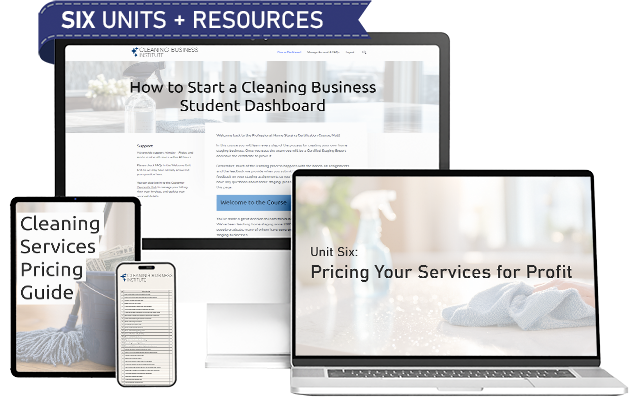
The work in this guide maps closely to three of the four extra units in the Fast Track Course.
Unit 8, Systems for Efficiency, covers scheduling tools, checklists and automated invoicing. Unit 9, Hiring and Growing Your Team, covers when to hire, vetting with a paid working session and training to your standard. Unit 10, Scaling and Long-Term Growth, covers the move from solo cleaner to owner and adding commercial contracts.
The Fundamentals Course covers the year-one base, including Unit 2 on bookkeeping and policies and Unit 5 on client retention. It suits someone still building that foundation, and it can be upgraded to the full course later.
Ready to get started?
Our step-by-step courses take you from where you are now to a credential you can show, with templates, an online exam, and a 30-day money-back guarantee.
See the courses