How to Set Up a Cleaning Business, From Bank Account to Policies
To set up a cleaning business properly, work through the admin in order. Choose a structure and register, get an EIN, open a business bank account, set up simple bookkeeping, choose how clients will book and pay, and write the forms and policies every client signs. Done in that order, the whole setup fits in two or three weeks around other commitments.
This guide covers that back office, the part clients never see but which decides whether month three runs smoothly. The legal registrations themselves have their own guides, linked below, so this one stays on the bank, the books, the software, the forms and the policies.
The order to set things up in
Order matters because each step needs something from the one before. A bank will usually ask for the EIN and formation papers. The bookkeeping needs the bank account to connect to. The client agreement needs the policies to be decided first.
Here is the sequence most new owners follow.
- 1
Structure and registration
Decide between sole proprietor and LLC, register the name and any local license.
Hands on formation papers - 2
EIN
Apply online with the IRS, free, and receive the number at the end of the session.
Hands on the number a bank asks for - 3
Business bank account
Open it in the business name and run every dollar of business money through it.
Hands on one clean record of money in and out - 4
Books, booking and payments
Connect bookkeeping to the account and choose how clients book and pay.
Hands on the terms the policies must match - 5
Forms and policies
Write the service agreement, cancellation and payment policies, and the quote and invoice.
Step one is where most of the legal questions sit. The guides on how to register a cleaning business and getting an LLC for a cleaning business cover it in full. Insurance is a separate decision again and should be in place before the first clean.
Getting an EIN and opening the bank account
An EIN, or Employer Identification Number, is the federal tax ID for a business. A sole proprietor with no employees can sometimes use their Social Security number instead, but most banks ask for an EIN to open a business account. It also keeps your Social Security number off invoices and contractor forms.
The IRS's EIN application page explains that applying online is free and the number is issued at the end of the session. Be wary of websites that charge to apply on your behalf. They file the same free form.
With the EIN in hand, open the bank account. The SBA's guide to opening a business bank account lists what banks usually ask for, including the EIN, formation documents and any business license. Compare fees and transfer limits, and check how easily the account connects to bookkeeping software.
Then keep the account clean. Every client payment goes in and every business cost comes out of it, with no personal spending mixed in. For an LLC, mixing the two can weaken the liability protection the structure exists to give.
Setting up bookkeeping that takes an hour a week
Bookkeeping means recording every dollar in and out, with a receipt or invoice behind it. A new cleaning business does not need an accountant for this. It needs a simple system and a fixed weekly slot to keep it current.
Money and paperwork are where new businesses trip first. Across the new owners we work with at the Cleaning Business Institute, more than nine in ten hit a money or paperwork problem in their first year. The ones who sort it out quickly are almost always those with a separate account and a weekly hour set aside for the books.
A workable setup has four parts.
- Bookkeeping software or a spreadsheet linked to the business account, so transactions arrive on their own.
- Categories that match your costs, such as supplies, fuel, insurance, phone, software and marketing.
- Receipts photographed the day you buy something and attached to the transaction.
- A mileage log, since driving between homes is one of the biggest costs in the trade.
The IRS's recordkeeping guidance explains which records a small business should keep and how long to hold them. Setting aside a fixed share of each payment for tax at the same time avoids a hard quarter later.
What the weekly hour covers
The weekly slot only works if it has a fixed routine. Pick the same day each week, ideally one with a light cleaning schedule, and work through the same short list every time.
- Match each payment in the bank feed to an invoice, and chase anything overdue.
- Categorize the week's costs and attach any missing receipts.
- Add the week's miles to the log.
- Move the tax share of the week's income into a separate savings account.
The tax share deserves a number of its own. A sole proprietor or single-member LLC owner pays income tax and also self-employment tax, which the IRS's self-employment tax page sets at 15.3% of net earnings for Social Security and Medicare. Ask an accountant once, early, what share to set aside in your state, then let the routine handle it.
Choosing software for booking and payments
A brand-new business can run on a shared calendar and a payment app. That works for the first handful of clients. Once there are more than about ten recurring homes, a dedicated tool usually saves more time than it costs, because it handles reminders, recurring bookings and payment in one place.
Whatever you choose, check that it does these things before committing.
- Books recurring cleans on a fixed rhythm, such as weekly or fortnightly.
- Sends reminders to clients before each visit.
- Takes card payment and stores the card for recurring clients, with their consent.
- Keeps notes on each home, such as entry codes and pets.
- Exports to your bookkeeping, or connects to it directly.
The guide to the best CRM for a small cleaning business compares the main options. Get a separate business phone number at this point too, so client calls and messages stay apart from personal ones.
An email address on the business's own domain does the same job for written messages, and looks more established on a quote. Owners who work from home may also want a mailing address that is not their house, since a registered address can appear in public records. A mailbox service or registered agent can provide one.
The forms and policies every client should see
Policies are the rules for the situations that cause arguments. Writing them before the first client means every client hears the same rules, and nobody can say they were made up on the spot. Each policy then goes into the service agreement the client signs.
These are the policies most cleaning businesses need from the start.
- Cancellation
- How much notice a client must give, and what is charged when they give less.
- Lockout
- What happens when the cleaner arrives and cannot get in, usually a partial or full charge.
- Payment
- When payment is due, how it is taken, and what happens when it is late.
- Keys and access
- How keys and codes are stored, who holds them and how they are returned.
- Damage and complaints
- How a client reports a problem, how fast you respond, and how breakages are handled.
With the policies settled, the documents follow. A cleaning service contract template covers the agreement, and the cleaning business invoice template covers billing. Keep the language plain, since a client who understands the policy is far less likely to dispute it.
The last piece is a written checklist for each service. It is both an operations document and a policy, because it defines what the price includes. Anything not on it is an add-on, which avoids the slow creep of unpaid extra tasks.
How the course fits
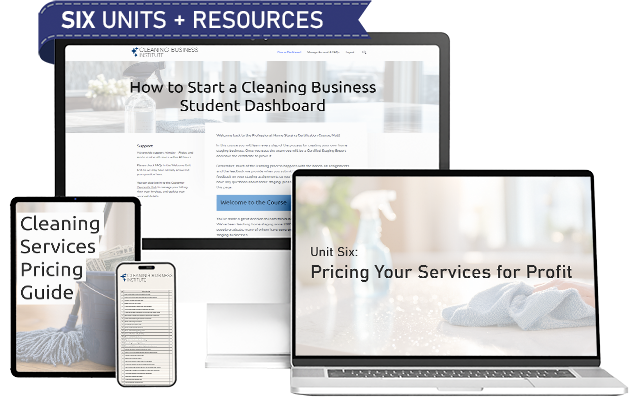
This setup is the subject of Unit 2, Setting Up Your Business, in the Fundamentals Course. It covers registering the name, choosing a structure, simple bookkeeping, the business bank account and the cancellation, payment and scheduling policies. Unit 1 covers the legal basics and startup budget that come before it.
The Fast Track Course adds Unit 8, Systems for Efficiency, which takes the booking, invoicing and reminder setup further once the client list grows. For a printable overview of the whole launch, the cleaning business startup checklist puts every step on one page.
Ready to get started?
Our step-by-step courses take you from where you are now to a credential you can show, with templates, an online exam, and a 30-day money-back guarantee.
See the courses