How to Register a Cleaning Business, From Name to Tax ID
To register a cleaning business, choose and check a name, file it with your state or county (as an LLC or a DBA), get an EIN from the IRS if you need one, and register with your state for sales tax and payroll where they apply. A sole proprietor using their own legal name may have almost nothing to file beyond a local license.
Registration is a set of filings rather than one form, and each tells a different government that the business exists. The name filing tells the state or county what the business is called. The EIN tells the IRS how to identify it. The state tax accounts tell the revenue department to expect returns.
What registering a cleaning business means
People use "register" and "license" as if they were the same thing, and they overlap. In this guide, registering means the filings that give the business a name and a tax identity. Licensing means the permission to trade in a particular city or county, which our guide to getting a cleaning business license covers.
The two connect, because the license application asks for the registered name and tax ID. So registration usually comes first, and the license follows a few days later.
The filings are easier to keep straight when each is set against the office that takes it.
| Filing | Filed with | Needed when |
|---|---|---|
| LLC or corporation | Secretary of State | The owner chooses that structure |
| DBA or trade name | County clerk or state, by state | Trading under a name that is not the legal one |
| EIN | The IRS | Hiring, forming most entities, or banking |
| State tax accounts | State revenue and labor departments | Cleaning is taxable, or staff are hired |
Most owners start with two or three of these, not all four. The rest of this guide takes them in the order they are usually filed.
Choosing and checking the business name
The name comes first because every later filing uses it. Changing it after the EIN, bank account and license are in place means updating each one, so it pays to check it properly now.
A good cleaning business name says what the business does, is easy to spell on a phone call, and does not tie the business to one service or one suburb it may outgrow. The cleaning business name generator is a quick way to build a shortlist.
Before settling on one, run these checks.
- Search the Secretary of State's business database for the same or a confusingly similar name.
- Search the USPTO trademark search for registered marks in cleaning services.
- Check that a matching web domain and social media handles are free.
- Search the name with your city to see whether a local business already uses it.
The Small Business Administration's guide to choosing a business name explains the difference between these layers. A state filing stops another entity in the same state registering the same name, but it does not give trademark rights, and a business elsewhere with a trademark could still object.
Registering the name with the state or county
How the name is registered depends on the structure. There are two common routes, and the choice of structure decides which one applies.
As a sole proprietor
A sole proprietor trading under their own full legal name, such as "Maria Lopez", usually files nothing for the name. Once the business uses any other name, such as "Lopez Home Cleaning" or "Bright Path Cleaning", most states require a DBA ("doing business as") filing, also called an assumed name or fictitious name.
Depending on the state, the DBA is filed with the county clerk or the Secretary of State. It is usually a short form and a small fee, and some states require it to be renewed after a set number of years.
This is the route most new cleaners take. Here at the Cleaning Business Institute, close to nine in ten of the students who come to us already trading on their own are registered as sole proprietors, a share that has barely moved over the past two years.
As an LLC
An LLC's name is registered when the articles of organization are filed with the Secretary of State, so no separate name filing is needed for that name. If the LLC trades under a different name, for example "Bright Path Cleaning LLC" trading as "Bright Path", it files a DBA as well.
Whether to form an LLC at all is its own decision, covered in our guide to forming an LLC for a cleaning business.
Getting an EIN from the IRS
With the name registered, the business can get its federal tax ID. An Employer Identification Number identifies the business to the IRS, much as a Social Security number identifies a person.
The IRS issues it free through its online EIN application, and the number is issued as soon as the application is finished. A business needs one if it has employees or is a multi-member LLC or corporation, and most banks ask for one to open a business account.
A sole proprietor with no staff can legally use their Social Security number instead. Many get an EIN anyway, because it keeps their personal number off invoices, contracts and the forms commercial clients ask contractors to fill in.
Registering with the state for tax
The last registrations tell the state to expect tax returns. Which ones apply depends on the state and on whether the business has staff.
- Sales tax. Some states tax cleaning services and most do not. Where they do, the business needs a permit before it charges for taxable work.
- Payroll withholding. A business with employees registers to withhold state income tax, in states that have one.
- Unemployment insurance. Employers register with the state labor or workforce agency.
- Local business tax. A few cities and counties collect a gross receipts tax alongside or instead of a license.
Many states now run a single online portal that handles several of these at once. Searching the state's name with "business registration" usually finds it, and the state's own site is the only source to trust on whether cleaning is taxable there.
After registration, the license and the bank
Once the name, EIN and state accounts are in place, two more steps finish the setup. The first is the local license, which our guide to cleaning business license requirements explains.
The second is a business bank account, opened with the EIN, the formation papers or DBA certificate, and photo ID. Running every payment through it from the first job is what keeps the books clean, and for an LLC it is part of what keeps the liability protection intact. The cleaning business startup checklist lists both, with the filings above, in order.
Keeping the registrations current
Registration is not quite a one-time job. Each filing carries a small amount of upkeep, and most of the problems owners run into later come from a change nobody reported.
These are the events that should prompt a check of every registration on the list.
- Moving. A new address goes to the state, the county, the IRS and the licensing office, and a move across a city line may need a new license.
- Changing the name. A new DBA, or an amendment for an LLC, then an update to the bank, the license and client contracts.
- Changing structure. A sole proprietor who forms an LLC should check whether the IRS requires a new EIN, then move the bank account and license into the LLC's name.
- Hiring the first employee. The payroll and unemployment accounts above, opened before the first payday.
- Renewal dates. DBAs in some states, LLC annual reports in most, and local licenses every year.
A single page listing each registration, its number, the office that holds it and its renewal date takes ten minutes to set up. It saves the scramble when a commercial client asks for proof of registration before signing.
Where the course covers registration
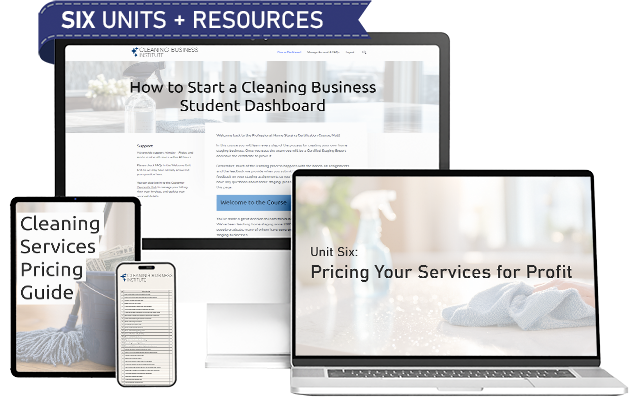
Registering the business is the opening topic of Unit 2 of the course, Setting Up Your Business. The unit covers registering the name and obtaining permits, choosing a structure, opening the business bank account, simple bookkeeping, and the cancellation, payment and scheduling policies a new business needs from its first client.
Unit 2 is part of the Fundamentals Course, which covers units 1 to 6. The Fast Track Course includes the same units and continues through hiring and scaling, where the payroll registrations above become routine.
Ready to get started?
Our step-by-step courses take you from where you are now to a credential you can show, with templates, an online exam, and a 30-day money-back guarantee.
See the courses