Remote Cleaning Business, What It Is and How to Start One
A remote cleaning business is one where the owner runs the business and other people do the cleaning. The owner handles sales, scheduling, quality control, payroll and client relationships, often from a phone or laptop, while employees or contractors clean the homes and offices. It is a real model, but it is not passive income, and few owners start that way.
Most remote owners got there by cleaning first, hiring one person at a time, and replacing themselves with systems and a supervisor over several years. This post gives an honest account of that route, what it costs in margin, and the legal question about who your cleaners actually are.
What the remote model is, and what it is not
The phrase is used loosely online, and some of the uses oversell it. A remote cleaning business still depends on cleaning, done well, in clients' homes and buildings. What moves is the owner's role, from doing the work to organizing it. The model has some firm edges.
- It is management, not absence. Owners still answer complaints, cover sick calls, hire and fire, and check quality. They just do it away from the mop.
- It needs people you can trust unsupervised. Cleaners hold keys and work alone in clients' property.
- It trades margin for scale. Every hour a cleaner works pays a wage before it pays the owner.
- It is not a shortcut for beginners. An owner who has never cleaned professionally struggles to price, train or judge the work.
Be wary of any pitch that describes a remote cleaning business as passive or hands-off from day one. The businesses that run without their owner on site got there by building the pieces in this post, in roughly this order.
The honest path from solo cleaner to remote owner
Remote operation is the last stage of a sequence, not a starting choice. Each stage builds what the next one relies on, which is why skipping one tends to fail. An owner who hires before writing a checklist, for example, ends up re-cleaning homes after their staff.
The stages below are typical rather than fixed, and the time each takes varies with the owner's market and appetite for hiring.
- 1
Clean it yourself
Build a client base, learn how long jobs really take, and write the checklist you follow.
Hands on a priced, written standard - 2
Hire and work alongside
Bring on one or two cleaners and train them on real jobs until they meet your standard.
Hands on cleaners who can work alone - 3
Manage instead of clean
Move into scheduling, inspections, sales and client care while the team does the cleaning.
Hands on systems that work without you - 4
Promote a lead
Put a trusted cleaner in charge of daily quality and staffing, and step back to oversight.
The fourth stage is the one that makes a business remote, and it depends on size. A supervisor's pay has to come out of the margin on many cleaners' hours. O*NET counts about 270,000 supervisors of housekeeping and janitorial workers against roughly 3.8 million janitors, maids and housekeepers, about one for every fourteen.
Owners who reach that stage tend to look similar. Here at the Cleaning Business Institute, the owners we have worked with over the past three years who stepped back from cleaning typically ran about a dozen to fifteen cleaners for each lead or supervisor by the time they did.
What a remote owner's week looks like
Stepping back from cleaning does not empty the diary. It fills it with different work, much of which can be done from anywhere with a phone signal. A typical week for an owner at the fourth stage includes these jobs.
- A weekly call with the lead about staffing gaps, inspection scores and complaints.
- Reviewing the schedule, payroll and unpaid invoices.
- Sales work, such as quoting new clients and following up proposals.
- Interviews, since cleaning businesses replace staff constantly.
The owner is still the person clients call when something goes badly wrong. Remote means the business does not need them in the homes, not that it does not need them at all.
Employees, contractors and who controls the work
Many remote models online rely on independent contractors, because contractors do not need payroll, benefits or workers' compensation. That choice is not the owner's to make freely. Whether a cleaner is an employee or a contractor depends on the working relationship, not on what the paperwork calls them.
The IRS guidance on independent contractors and employees looks at who controls how, when and where the work is done. A cleaning company that sets the schedule, supplies the checklist and products, and trains people to its standard is exercising a lot of control. Many state labor departments apply their own, sometimes stricter, tests.
Which means the very things that make a remote model work (a fixed standard, set schedules, training, inspections) also point toward employment. Check your state's rules, take advice before building on contractors, and read our guide to hiring cleaners for the wider picture.
The systems that stand in for the owner
Once the owner is no longer in the homes, systems do the job the owner's eyes used to do. Each one replaces a specific thing the owner used to check personally, and a gap in any of them shows up as a client complaint.
The systems a remote cleaning business cannot run without are these.
- Written standards
- A checklist per job type and per client, detailed enough that any trained cleaner produces the same result.
- Scheduling software
- Bookings, routes and changes in one place, so a sick call is a reassignment rather than a crisis.
- Photo proof
- Finished-room photos from each visit, reviewed by the lead, so quality is visible from a distance.
- Inspections
- Unannounced checks by the lead on a rotating list of clients, scored against the checklist.
- Key control
- A log of every key, fob and code, who holds it, and when it was returned.
- Client feedback
- A short check after early visits and periodically after, so problems arrive before cancellations.
Most of these run through one piece of software in a business of any size. Our guide to choosing a CRM for a cleaning business covers what that software needs to do.
The money, worked honestly
The remote model's appeal is a higher ceiling, and its cost is a lower margin on every hour. A solo cleaner keeps most of what a client pays. An owner with a team keeps what is left after wages, payroll costs and supervision. The gap is large, and it is the reason the model needs scale.
Here is the working for one billed hour under both models, at illustrative rates.
A solo owner cleaning 25 hours a week keeps about $1,075. To match that, a team has to bill about 75 hours a week, and more once the owner stops cleaning entirely.
That arithmetic is why the remote stage arrives late. Owners with two or three cleaners often earn less than they did alone, while working just as hard. The payoff comes with volume, and with a business that has value beyond the owner's labor. The cleaning business earnings calculator compares solo and small-team models with your own prices.
For how teams, managers and routes grow past that point, our guide on how to scale a cleaning business picks up where this one stops.
How the course fits
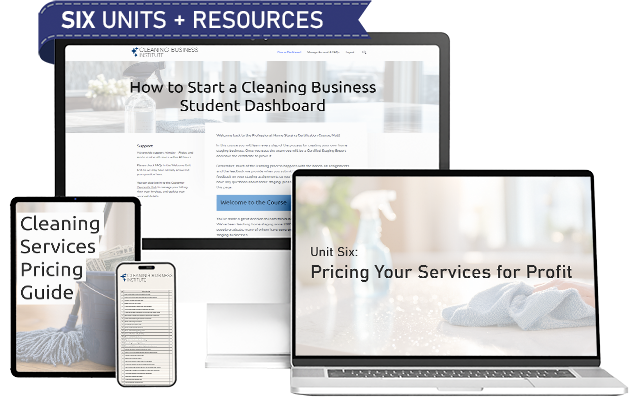
The Fast Track Course covers the parts of the route that turn a solo business into one the owner can run from a distance. Unit 8, Systems for Efficiency, covers scheduling tools, checklists and automated invoicing. Unit 9, Hiring and Growing Your Team, covers finding, vetting and training cleaners, including a paid working session before anyone holds a key.
Unit 10, Scaling and Long-Term Growth, covers the move from solo cleaner to business owner. Those three units sit only in the Fast Track tier. The first six, which cover pricing and the stage-one business every remote owner starts with, are also in the Fundamentals Course.
Ready to get started?
Our step-by-step courses take you from where you are now to a credential you can show, with templates, an online exam, and a 30-day money-back guarantee.
See the courses