How to Introduce Your Cleaning Business, With Examples
To introduce your cleaning business, say four things in this order. Say who you are, what you clean and where, one specific reason to trust or choose you, and what the person should do next. Keep it short enough to say in thirty seconds, and change the middle two parts to suit whoever is listening.
The same formula works on a doorstep, at a networking event, in an email to an office manager and on your website. Below are worked examples of each, which you can adapt to your own business and area.
The four-part formula behind every good introduction
A good introduction is not a speech. It is a short answer to the questions a prospect is already asking in their head, put in the order they ask them.
- Who you are
- Your first name and the business name, said clearly enough to remember.
- What and where
- The kind of cleaning you do and the area you cover, in plain words.
- Why you
- One specific, true reason to choose you, such as insured, the same cleaner every visit, or a written checklist.
- The next step
- A single easy action, such as a free quote, a walkthrough, or a referral to someone they know.
The third part is where most introductions go wrong. "We do a great job" is not a reason, because every cleaner says it. "You get the same cleaner every visit, with a checklist you can see" is a reason, because a prospect can picture it and hold you to it.
Fit the introduction to the person listening
Homeowners and businesses want different things from a cleaner, so the "why you" part should change with the listener. The formula stays the same, but the reason you lead with does not.
A homeowner is letting someone into their personal space. They care most about trust, reliability and how the home will look when they walk in. An office or facility manager cares about consistency, whether you can work after hours without supervision, and whether you will cause them complaints from staff.
Here is how the same four parts shift between the two kinds of listener. Only the middle two change, and that is where the work of tailoring goes.
| Part | For a homeowner | For an office manager |
|---|---|---|
| What and where | Regular house cleans in your neighborhood | Evening office cleaning across the business park |
| Why you | Insured, and the same cleaner every visit | A written scope and a monthly walkthrough |
| The next step | A free quote by message | A fifteen-minute walkthrough of the space |
If you are still deciding which market to focus on, how to start a commercial cleaning business sets out the differences.
Spoken introductions, with examples
Face to face, people judge your manner as much as your words, so the spoken versions should sound like conversation. The three examples below use made-up names and businesses, so swap in your own details.
The casual neighbor introduction
This one is for a school pickup, a street party, or the moment someone asks what you do.
"I'm Sarah, and I run Brightwell Home Cleaning here in town. We do regular house cleans every week or two, plus deep cleans and move-outs. Most of my clients just like coming home to a clean house without losing their weekend to it. If you ever want a hand, I'm happy to give you a free quote."
It works because it is warm, names the services, gives a client's reason rather than a boast, and ends with an offer that is easy to accept or ignore.
The thirty-second pitch for a networking event
At a business group or chamber event, you have about thirty seconds before the conversation moves on, and the listener is usually another business owner.
"I'm Michael with Clearline Services. We clean offices and retail spaces across the metro area, in the evenings. The thing clients notice is that each account gets a dedicated team, so it's the same people every visit. If you know a business owner who's frustrated with their current cleaner, I'd be grateful for an introduction."
Notice that it asks for a referral rather than a sale. At a networking event the person in front of you is more likely to know a buyer than to be one, so asking for an introduction gets a better response.
The doorstep introduction at a walkthrough
When you arrive to quote a job, the first sentence sets the tone for the whole visit.
"Hi, I'm Jessica with Fresh Start Cleaning. Thanks for having me over. I'd like to walk through the house with you first, so I understand what matters most to you, and then I'll put together a written quote. Does that sound good?"
It puts the client in charge, shows you care about their priorities, and promises something specific at the end. That is a better start than a list of services they could have read online.
Written introductions, with examples
Written introductions do not have your voice or manner behind them, so the words carry all the weight. They also last longer, since a website page or a bio may be read hundreds of times.
The About page on your website
"Brightwell Home Cleaning is a locally owned, fully insured cleaning business serving the north side of Springfield. It was started by David, who grew up here and wanted to offer the kind of reliable, careful cleaning his own family struggled to find.
"Every clean follows a written checklist, and you get the same cleaner each visit. We offer weekly, biweekly and one-time deep cleans. Book a free walkthrough to get started."
It covers all four parts, adds a short and believable reason the business exists, and ends with one action. Keep every claim in it true. Under the FTC Act, 15 U.S.C. 45, deceptive claims in advertising are unlawful, and words like "insured" or "background-checked" are claims a client can check.
An introduction email to an office
A cold email works when it is about the recipient's building rather than your history. It should be short, specific and end with one clear question.
"Hi Ms. Lopez, I'm Daniel with Clearline Services. We clean small offices in the Riverside business park, including two on your street, in the evenings after staff leave. Each office gets the same team and a written checklist. I'd be glad to walk through your space and give you a quote with no obligation. Would Tuesday or Thursday afternoon suit for a fifteen-minute visit?"
The closing question matters more than it looks. Here at the Cleaning Business Institute, we've found that introduction emails ending with one clear question have drawn about half as many replies again as those ending with none, over the past two seasons.
Commercial email also falls under the CAN-SPAM Act, summarized in 15 U.S.C. 7704, so include your business address and honor any request to stop.
A social media bio
A bio has room for a single line, so it carries the formula in shorthand.
"Home and move-out cleaning in north Denver. Insured, same cleaner every visit. Free quotes by message."
Add a number, such as how many reviews you have, only when it is true and current. A bio that still says "50 happy clients" two years later undersells you, while one that inflates the count is a claim you cannot back.
A letter to a referral partner
Realtors, property managers and moving companies are worth a written introduction of their own. The cleaning business introduction letter template gives you a structure for that letter, built on the same four parts.
Mistakes that weaken an introduction
Even with the formula in hand, a few habits undo good introductions. Each is easy to fix once you hear yourself doing it.
- Being vague. "I clean houses" gives no reason to choose you over anyone else. Name the service, the area and one specific reason.
- Leading with price. Opening with "we start at $99" makes you a commodity before the person knows what they would get. Price belongs in the quote.
- Apologizing for being new. "I've only just started" sounds unsure even when your work is excellent. Say what you do and how, instead.
- Talking too long. If an introduction takes more than thirty seconds out loud, cut the middle until it does not.
Practice helps more than people expect. Say your introduction aloud a few times before a networking event or a walkthrough, and it will come out as conversation rather than a recital. For how introductions fit into finding the first bookings, see how to get clients for a cleaning business.
Where the course covers outreach and scripts
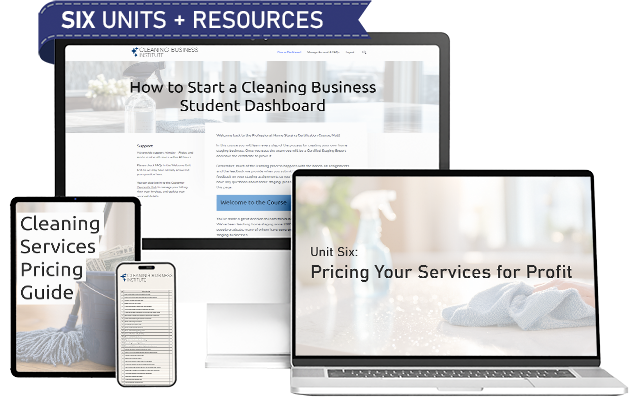
Unit 6 of the Cleaning Business Institute course, Getting Your First Clients, includes scripts and templates for reaching out to potential clients confidently, along with the introductory offer that gives an introduction its next step. Unit 5, Client Experience and Retention, covers setting expectations and communicating professionally once a prospect becomes a client. Both are in the Fundamentals Course.
Unit 10, Scaling and Long-Term Growth, covers commercial contracts and building a brand that stands out locally, which is where the office introductions above lead. It is part of the Fast Track Course.
Ready to get started?
Our step-by-step courses take you from where you are now to a credential you can show, with templates, an online exam, and a 30-day money-back guarantee.
See the courses