Increase Sales in a Cleaning Business From Clients You Have

To increase sales in a cleaning business without finding new clients, sell more to the clients you already have. Revenue per client comes from three places: add-on services on top of the regular clean, more frequent visits, and clients who stay for more years. Each can be sold without pressure, because each solves something the client already wants.
This is the cheapest revenue a cleaning business can earn. The client already trusts you, the house is already on a route, and there is no advertising to pay for. Getting new clients matters too, but it is a separate job, covered in how to get clients for a cleaning business.
The three numbers behind revenue per client
A recurring client's value is three numbers multiplied together. What they pay per visit, times how many visits a year, times how many years they stay. Raise any one of them and the total goes up, and raise all three a little and the total goes up a lot.
That is easiest to see on one client. The example below is an illustration with stated assumptions, not a market figure. It follows a fortnightly client at $140 a visit, first as they are, then with a quarterly add-on and one more year of staying.
The same client is worth $4,180 more, with no new marketing and only four short extra tasks a year.
Most of that gain came from the extra year, not the add-on. That is the usual pattern, and it is why retention gets its own section below.
Price per visit is the first of the three numbers, but it is a pricing question more than a sales one. An owner who is underpriced will find every add-on and extra visit earns less than it should, so fix the base rate before pushing the rest.
The post on cleaning business pricing covers hourly, flat-rate and per-room models and when each fits. Once the base rate is right, the add-on menu and frequency offers below can be priced from it.
A caution applies to discounts. A small discount for committing to a recurring schedule makes sense, because the visits are cheaper to deliver. Discounts that only buy a booking, such as half price for the first clean, tend to attract clients who leave when the full price arrives.
With the base rate settled, extra sales come from adding to each visit, adding visits and adding years. Add-ons and frequency are quicker to sell than loyalty, so they come first.
Sell add-ons the client already wants
An add-on is a task outside the regular clean, priced separately, such as the inside of the oven or the windows. Clients usually want these done. They simply do not think to ask, or assume the cleaner would say no.
So the job is to make add-ons visible and easy to say yes to. A short, fixed-price menu works better than quoting each one. These are the add-ons most residential clients buy:
- Inside the oven and the fridge, often quarterly.
- Interior windows and tracks, usually spring and autumn.
- Inside kitchen cabinets, or a pantry wipe-out.
- Baseboards, door frames and blinds by hand.
- Laundry folded or beds changed with fresh linen.
- A seasonal deep clean before the holidays or a family visit.
The best moment to offer one is when the cleaner has just noticed the need. A note left after the clean, saying the oven is due and can be added next visit for a set price, is helpful rather than pushy. Put the menu on a cleaning services price list so every client sees the same prices.
Timing matters as much as the menu. A few natural moments come round for every client, and each is a chance to mention one add-on rather than the whole list:
- The first walkthrough, when the client is already describing what bothers them about the house.
- The booking confirmation, with one line naming a seasonal add-on and its price.
- The note left after a clean, when the cleaner has just seen the need.
- A short message a month before the holidays, school breaks or spring.
One mention at each moment is plenty. A client offered something every visit starts to feel sold to, and that feeling costs more than the add-on earns.
Some clients ask for greener products for health or allergy reasons. That can be a paid add-on or part of a premium tier. If you market it, use products with a recognized label, such as the EPA's Safer Choice program, rather than vague claims.
Raise how often each client books
Frequency is the second number. Moving a monthly client to fortnightly doubles their visits, and moving a one-time deep clean into a recurring booking turns a single sale into a year of them. Both are common, and both start with a clear offer.
The easiest conversion is right after a first deep clean. The house will never be easier to keep clean than it is that afternoon, so offer a recurring slot at a lower per-visit rate. The lower rate is fair, because a house cleaned every two weeks takes less time per visit than one cleaned monthly.
Monthly clients are the next group. Many chose monthly to save money and find the house slips in week three. A fortnightly offer framed around that, with the same cleaner on the same day, often lands. Run your numbers through the cleaning price calculator first, so each frequency still covers your costs.
Not every client should move up. A monthly client in a tidy two-person household may be well served as they are. Selling them a schedule they do not need tends to end in a cancellation, which costs far more than the extra visits would have earned.
Keep clients for more years
The third number, years kept, usually has the biggest effect. Clients who stay also tend to spend more over time. In a study of online shoppers, Bain & Company found grocery customers spent 23 percent more in their 31st to 36th months than in their first six.
Cleaning clients follow the same curve. Here at the Cleaning Business Institute, we've found that clients who have stayed with an owner for about three years spend roughly a quarter more a year than they did in their first six months, mostly through add-ons and more frequent visits.
Keeping clients is less about grand gestures than about removing small irritations. These habits do most of the work:
- Send the same cleaner or team on the same day, so the client never re-explains the house.
- Message before any change to the time or the cleaner, not after.
- Check in after the third visit and ask what should be done differently.
- Fix any complaint on the next visit, at no charge, and say so.
- Review prices once a year, with at least 30 days' written notice.
Each habit costs a few minutes. Together they remove most of the reasons a client starts looking elsewhere. The post on how to grow a cleaning business explains why retention comes before spending on new clients.
How to tell whether sales per client are rising
All of this is easy to start and easy to let slide, so it helps to watch a few numbers. Pull them from your booking or invoicing records once a month. Four are enough for a small business:
- Average revenue per recurring client per month. This is the headline figure, and it should rise slowly over a year.
- Share of clients who bought an add-on this quarter. If it is very low, the menu is not being seen.
- Average visits per client per year. This shows whether frequency offers are landing.
- Clients still booked after twelve months. This is the retention number, and the one that moves the total most.
A spreadsheet does the job at first. The cleaning business earnings calculator then shows what a change in any of these does to the owner's pay over a year.
Where the course covers revenue per client
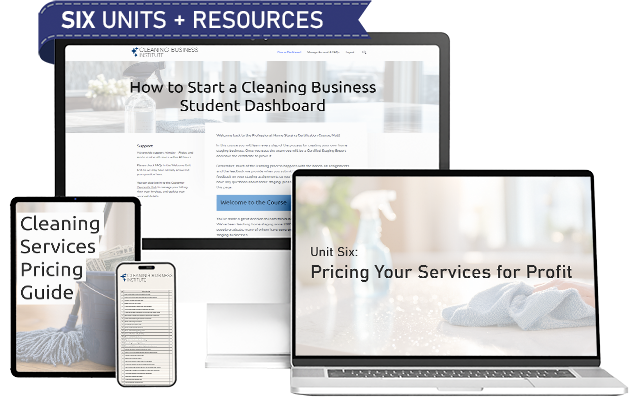
Two units of the Fundamentals Course, which are also in the Fast Track Course, deal with this directly. Unit 3, Pricing Your Services for Profit, covers building packages for different kinds of clients and handling price objections without discounting.
Unit 5, Client Experience and Retention, covers onboarding, setting expectations, handling feedback and the systems that bring repeat business and referrals. Together they cover all three numbers in the worked example above.
Ready to get started?
Our step-by-step courses take you from where you are now to a credential you can show, with templates, an online exam, and a 30-day money-back guarantee.
See the courses