How to Get Cleaning Contracts and Win Commercial Bids
To get cleaning contracts, pick a type of building you can serve well, find the person who buys cleaning for it, walk the site before you price, and submit a clear written proposal backed by insurance and references. Public contracts add a registration step and a formal bid. Most first contracts are small offices won by walkthrough and follow-up.
A cleaning contract is a written agreement to clean a site on a set schedule, for a set price, over a set term. Commercial contracts are usually for offices, clinics, shops, schools or shared areas of apartment buildings. This post covers how to find them, price them and win them.
Where commercial cleaning contracts come from
Contracts come from two broad places, private buyers and public ones, and they are won in different ways. Private buyers are usually the better place to start, because a small business can talk to the decision-maker directly and the paperwork is lighter.
These are the buyers most new commercial cleaners approach first:
- Small and mid-sized offices, where an office manager or owner buys cleaning, usually after hours. The post on office cleaning businesses covers keys, alarms and night work.
- Medical and dental clinics, which pay for reliability and closer attention to infection control.
- Property managers, who control the common areas of several buildings and the turnover cleans between tenants.
- Retail and gyms, which need daily cleaning outside opening hours.
- Larger janitorial firms, which sometimes subcontract buildings that fall outside their own routes.
- City, county, state and federal buyers, which use formal bids and are covered below.
Choosing one or two of these matters more than covering them all. A business that cleans dental clinics can show a new clinic its references, its products and its routine. That specificity wins more than a general claim to clean anything.
For the bigger decision of whether to move into commercial work at all, read how to start a commercial cleaning business. This post assumes that choice is made and the question is how to win the work.
How to find the buyer and win the walkthrough
The first goal is not a sale. It is a walkthrough, meaning a visit to the site with the person who buys cleaning, to see the building and hear what is wrong with the current service. Most buyers already have a cleaner, so their complaint about that cleaner is the opening.
Owners usually reach buyers by calling or visiting, asking for whoever looks after the building, and requesting fifteen minutes to see the space. A short leave-behind with your insurance, a reference and a contact number helps. The introduction letter template gives a starting point.
The walkthrough itself is where most bids are won or lost. The steps below are the usual order, from first contact to signed contract.
- 1
Reach the buyer
Find the office manager, practice manager or property manager who signs for cleaning.
Hands on a booked walkthrough - 2
Walk the site
Note every room, floor type, restroom and bin, and ask what the current cleaner misses.
Hands on a measured scope - 3
Time the work
Turn the square footage and fixtures into hours per visit using your own production rate.
Hands on labor hours a month - 4
Price it
Add labor, supplies, overhead and profit to reach a monthly figure.
Hands on a price you can defend - 5
Send the proposal
Scope, schedule, price, insurance and references, within a day or two of the visit.
Hands on a decision to chase - 6
Follow up
Check in on a set rhythm until you get a yes or a clear no.
Two of those steps decide most outcomes. Timing the work wrongly produces a price that either loses the bid or loses money for a year. Skipping the follow-up loses bids that were winnable, because buyers are busy and decisions slip.
How to price a cleaning contract bid
Commercial cleaning is usually priced per month, built up from the hours the site needs. The key input is a production rate, meaning how many square feet one cleaner can clean in an hour on that kind of site. It varies widely with floor type, clutter and restroom count, so it should come from your own timed cleans.
The example below is an illustration with stated assumptions, not a market rate. It prices a 12,000-square-foot office cleaned five nights a week, at an assumed 2,500 square feet an hour and $22 an hour in loaded labor cost.
Dividing the $2,753 cost by 0.85 gives about $3,240 a month, leaving $487 of profit if the hours hold.
The weakest number in that ledger is the production rate. If the office really takes 6 hours a night, labor rises to about $2,860 and the profit is gone. That is why the walkthrough and a timed trial clean matter more than any pricing formula.
Price is also the reason most bids are lost. In its 2024 RFP benchmarks report, Loopio found an average win rate of 43 percent across industries, with price the most common reason for a loss.
Cleaning bids show the same shape. Among the owners we work with at the Cleaning Business Institute, most report winning a little under half of the commercial bids they have submitted over the past two years, and price is the reason they hear most often for the ones they lose. For pricing models beyond the commercial case, see cleaning business pricing.
What a cleaning contract should include
Once a buyer says yes, the agreement protects both sides. A vague contract leads to arguments about what was included, and those arguments usually end with the cleaner doing extra work for free. These are the terms most cleaning contracts set out:
- The scope, room by room, with how often each task is done.
- The days and hours of service, and how access works, including keys and alarm codes.
- The monthly price, invoice timing and payment terms.
- The term, how it renews, and the notice either side must give to end it.
- How the price is reviewed, such as once a year.
- Who supplies consumables like liners, paper and soap.
- Insurance held, with a certificate supplied, and how damage is handled.
- How quality is checked and how complaints are fixed.
The cleaning service contract template and the cleaning business proposal template cover these terms. Have a local attorney review your version once, since contract law varies by state.
Many commercial buyers also ask for proof of cover before signing. The posts on cleaning business insurance and getting bonded explain what each one covers.
How government cleaning contracts work
Public buyers clean a great many buildings, and their contracts can run for years. They are won through formal bids, usually a published request with a set format, a deadline and a scoring method. The work is the same, but the paperwork and the patience required are much greater.
Federal work starts with registration. A business must register in SAM.gov, the federal System for Award Management, to bid on federal contracts. Many contracts are set aside for small businesses, and whether yours counts as small depends on the SBA's size standards for your industry code.
State, county and city contracts use their own procurement portals, and rules differ from place to place. Check your state's procurement office and your city's purchasing department directly. A bond may be required for some public contracts, so confirm that before bidding.
Most small owners do better winning a few private contracts first. References from local offices strengthen a public bid, and the steady revenue makes the long wait for a decision easier to carry.
Where the course covers commercial contracts
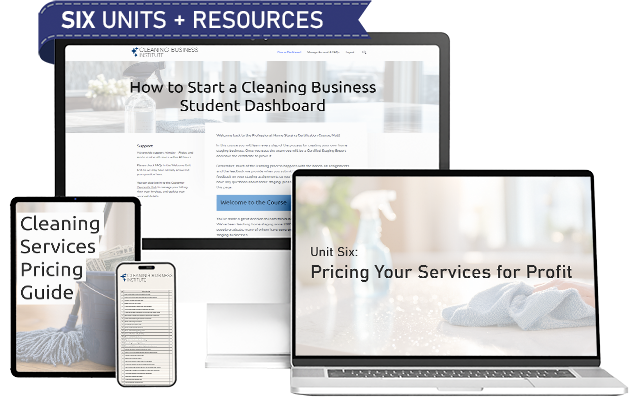
Adding commercial contracts for stable, recurring revenue is part of Unit 10, Scaling and Long-Term Growth, in the Fast Track Course. It sits alongside expanding your service area and building a brand that stands out locally.
The pricing behind any bid is covered in Unit 3, Pricing Your Services for Profit, which is in both the Fundamentals and Fast Track courses. It covers the true cost of running a cleaning business and when to price hourly, flat-rate or by square footage.
Ready to get started?
Our step-by-step courses take you from where you are now to a credential you can show, with templates, an online exam, and a 30-day money-back guarantee.
See the courses